
The alchemy of masterminding
9 Best practices to facilitate better meetings

Conscious leadership involves understanding and amplifying your team’s unique abilities.
Every individual in your team is great at certain things; it is your role to know what they are and to shape the circumstances for them to thrive.
Most leaders get that part. But let’s move up one level, from the individual to the collective (the team):
Why do you want to leverage the power of your team’s “collective mind”?
… because one innovative idea can transform your organization or save months of work.
… because engaged team members are happier, stay longer, and produce more.
… because a team that experiences true collective flow will remember that for the rest of their lives.
Napoleon Hill spoke of the mastermind principle as the number one key success factor to any endeavor. Your mastermind group is your team: a collective of individuals that 1) puts their minds together, 2) in a spirit of harmony, 3) towards a shared purpose.
The results are powerful:
Deep purpose alignment
A feeling of mutual connectedness
Exciting brainstorms where everyone feels engaged
Generating new ideas and insights beyond what any individual can grasp
Balanced conversations
Empowering everyone to 1) speak out, and 2) truly, attentively listen to the others
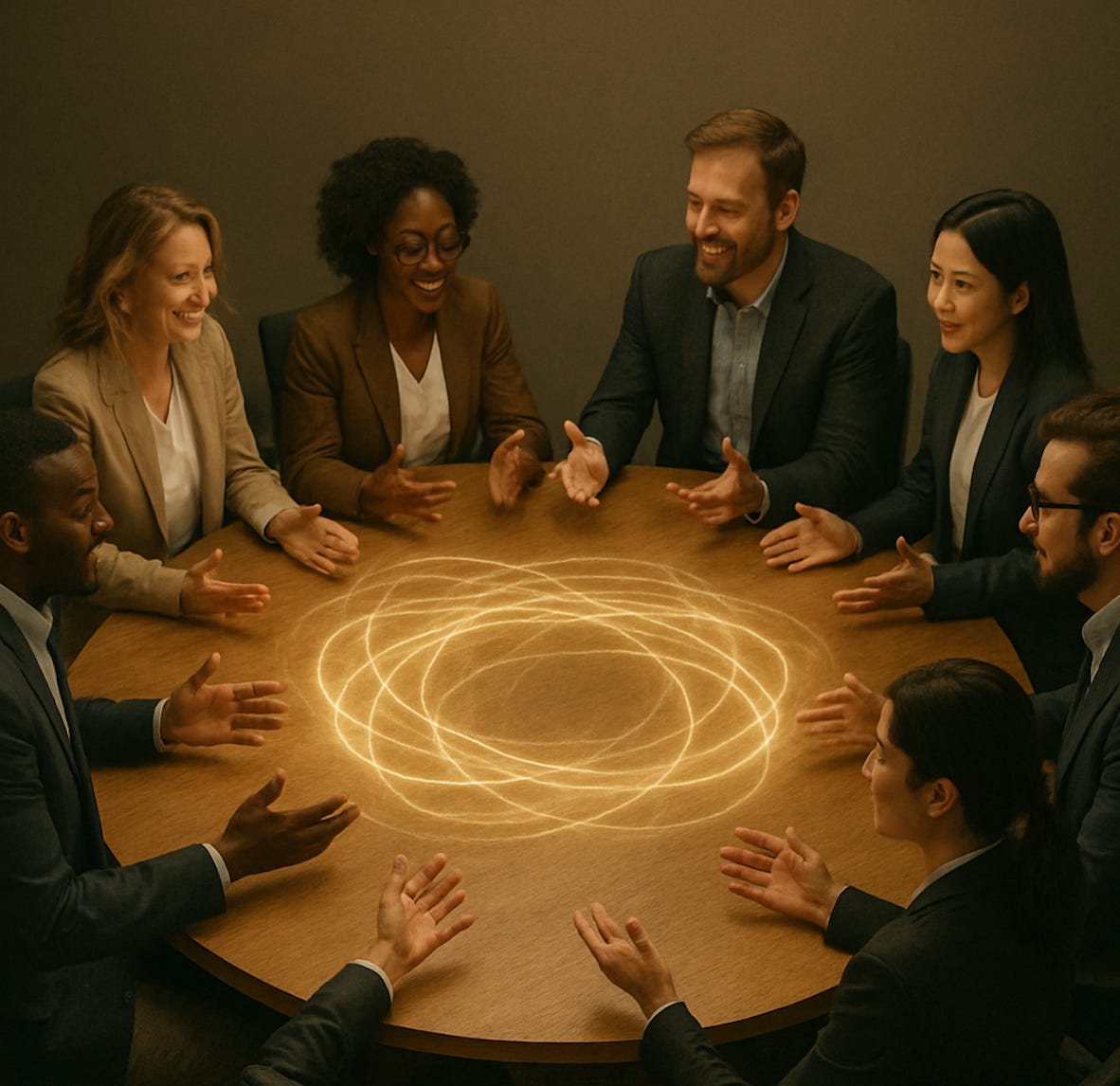
Every meeting can be like this, if facilitated properly.
Compare this to today’s standard: life-draining meetings with few concrete outcomes leave participants frustrated and depressed.
Becoming able to engage your team in productive masterminding may be one of the most meaningful and strategic things you can do for your organization.
A peek behind the curtain…
Several years ago, a colleague and I were asked to facilitate a team meeting of a starting community. They were in the process of buying land, making agreements, and finding alignment within the group when embarking on this adventure of a lifetime. There were some tensions in the team and important topics to be aligned on, so they requested an objective facilitator to guide the conversation.
We spent 2 hours together on Zoom. The two of us facilitated the conversation among the project’s initiator and his eight team members.
When the session almost finished, we asked everybody to share their personal reflection. I still remember one lady’s response (even the look on her face).
She seemed both blissful and confused in one. What she had experienced didn’t fit her frame of reference; both her past experiences and her mental model of how meetings work couldn’t explain the dynamics she experienced.
“I don’t get it. It felt so relaxed, like we were just hanging out - yet all the important topics were somehow covered. There wasn’t a pre-defined agenda, yet everything that needed to come up was discussed. Some very challenging topics were addressed, but they didn’t feel heavy. What would normally take a few hours of conversation, was now covered in a few minutes.”
“How come we were so productive, yet it never felt hasty? I need some more time to process this!”
The mechanics of human alchemy
Something very powerful happens when conversations “just flow”. As if a new entity, a collective mind, forms, joins, and brings in more presence, awareness, and intelligence to the table than anyone could alone.
Out-of-the-box ideas come up, simple solutions present themselves, and innovative strategies come up for situations that seemed stuck.
As a conscious leader, your invitation is to be the director of that process; a facilitator of teamflow. Make this your priority, your craft, your art - to evoke teamflow - and you’ll likely outperform other teams across all metrics.
Conscious leadership is about integrating your ego and showing up blank, ready to receive new information, prepared to have your beliefs and assumptions challenged - ready to adjust your personal truth as soon as new knowledge presents itself.
All in service of your team’s purpose, collective progress, and higher truth.
A skilled meeting facilitator is a human alchemist - designing and guiding the frame of a conversation, balancing structure and flow, space and focus, boundaries and freedom for authentic expression.
When you are able to provide a space for everyone to speak freely while making every word matter, to listen attentively and be heard, to openly share tensions and challenge assumptions - all in a spirit of harmony…
… that’s when a normal group can become a mastermind.
Best practices you can start applying today
Prevent role conflict: team leader vs. meeting facilitator
One common source of misalignment is that there is no separation between the roles of team leader and meeting facilitator.
Almost always, the team leader also guides the team meetings… which typically comes with conflicting interests and causes the leader’s voice to be over amplified - with little space for other voices or truly open explorations.
For the purpose of this article, let’s say you are a conscious leader who does indeed also take the lead in guiding your team’s meetings.
Just make sure you are aware to distinct between these two roles, and that (in most cases) your highest leverage is in guiding the process while resisting the temptation to push your own agenda and viewpoints on the content.
Clarity of purpose and intended outcomes
Every participant is aligned on the purpose, outcome, and why (POW):
What will we exactly be doing?
What’s our desired outcome?
Why is that important right now?
Quality questions
View your mastermind group as a wise oracle you can go to with your deepest, most profound questions. What are the most important things you need clarity on? What is the highest leverage prompt to ask your mastermind group?
Practice thinking in terms of questions to ask rather than answers to seek. Because the quality of your questions defines the quality of your world. Better questions lead to better outcomes.
The right people, tools and environment
Technology and context shape the experience, so use platforms and formats that support genuine interaction, flow, and connection. For example: sit in a circle whenever possible. And for online mastermind meetings, use CircleSpace instead of Zoom.
Nervous system regulation
Some teams are readier for this than others, but the science speaks for itself. Spending a few minutes on grounding, meditation, conscious breathing, or introspection - e.g. at the start of the meeting and when exploring a prompt - leads to deeper awareness, higher insights, and more profound inputs from all participants.
Personal check-ins and check-outs
Connect on a human level first – hearing everyone, building trust, tuning the field, and honoring the process – before diving into the content.
For check-ins, ask, for example: “What’s alive in you now, that you want to speak out so you can let it go and be fully present?”
For check-outs, close the circle with a final round of hearing everyone, by asking something like: “What’s the main learning, insight or lesson you’ll move forward with?”
A reminder of best practices
Invite conscious communication by reminding the participants of a few key principles. At the start of every Gaianet meeting, we remind ourselves of the Four Agreements (of Don Miguel Ruiz) to prime ourselves for active listening, an open mind, and full presence.
A balanced conversation
Your main focus should be to objective guide the process without getting (too) involved in the content. Ensure more or less equal sharing time for everyone. Give space to creativity and “side branches” in the conversation. Appreciate contributions.
Practice Wu Wei, effortless action: don’t force the format too strongly, and aim to act in alignment with the natural flow - giving space to “what wants to emerge”, letting the magic unfold.
While simultaneously being a guardian of the safe space. Be ready to cut off somebody who is oversharing, or redirect the group’s focus to the prompt or the desired outcome when needed.
A dedicated secretary to harvest the gold
Team meetings and conversations are only valuable when real tangible output is accomplished:
New insights and opportunities
Decisions
Next steps
As the facilitator needs all his / her focus and attention to hold the space, track time, manage the agenda and flow of the meeting, read the verbal and non-verbal cues in the room, continuously consider what’s next, and weave it all together… some help to write down everything the group needs to remember is very welcome.
The solution is simply to appoint a secretary at the start of the meeting (or even better, before the meeting) with the task to:
Capture the relevant insights, decisions, and next steps.
Share them immediately after the meeting (so everyone has the chance to stay in the flow and immediately work with what’s been discussed)
AI meeting notes are a nice add-on, but today I wouldn’t (yet) trust automated notes to be of the same quality as those of a dedicated team member.
Conclusion
There is a great need in today’s world for skilled facilitators and spaceholders. The unfolding of the new, conscious, regenerative, aligned paradigm in business and society depends on the ability of groups to come together in harmony - and this takes skillful facilitation.
You can start leading by example. Make this way of meeting the new normal within the micro cosmos of your own team and organization.
Help your team express deeper thoughts and truly hear each other.
This is not just a moral duty; it is the unseen accelerator for everything you’re after. Engagement, connection, innovation, meaning, and fulfillment… outperforming traditional teams across the board.
Are you ready to shift from being a “giver of instructions” to becoming a “director of alignment”?
With love,
Alexander
P.S. If your team needs to realign and you can use some help, consider bringing in an independent facilitator. This page explains how that works and how I can potentially support.